The real test for agentic AI has never been the chatbot interface. It has always been whether the infrastructure underneath ordinary products would quietly get rebuilt around AI-generated output, in ways most users would never notice. That is exactly what Adobe principal scientist Carlos Sanchez was describing at AIEWF when he demonstrated what he calls agentic sites: websites that assemble and personalize pages in real time based on a visitor’s intent. No fixed layout. No static content. Just a governed system that decides, on demand, what to show you and how.
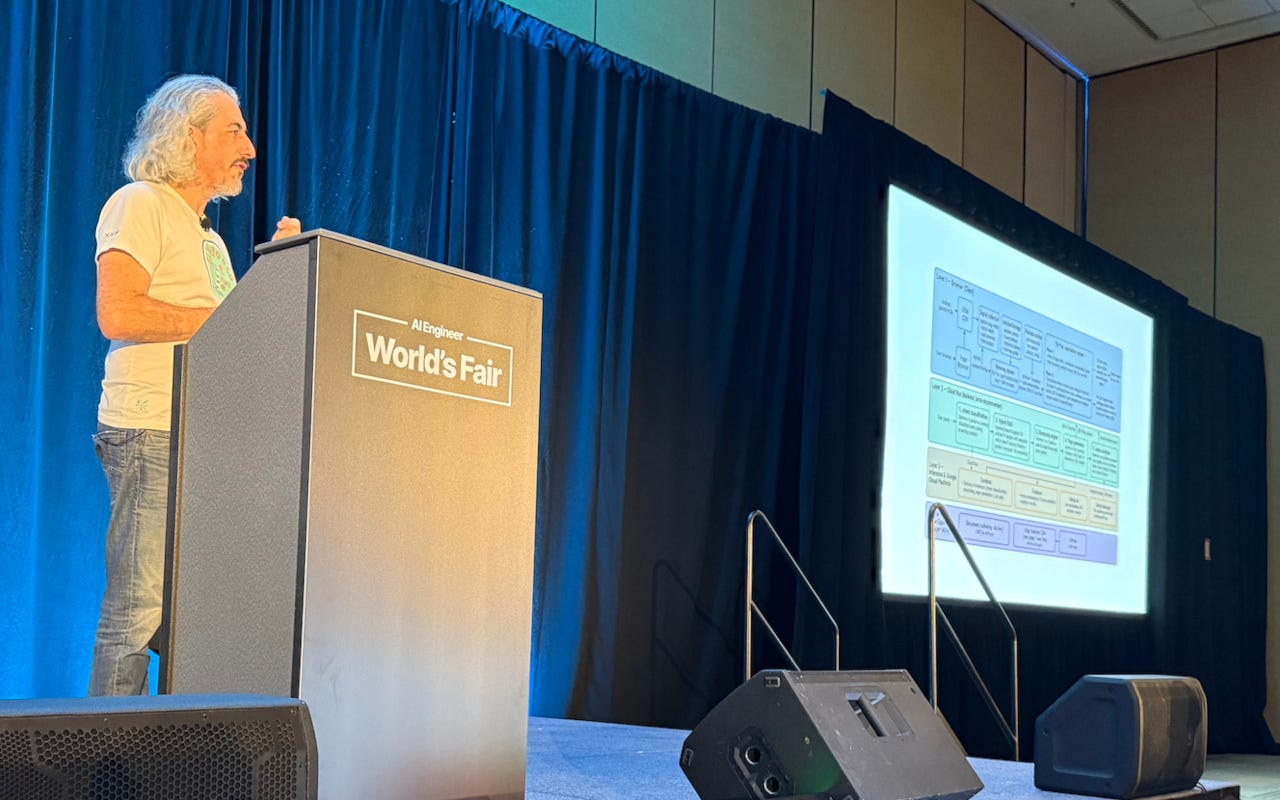
Sanchez framed the transition with the kind of matter-of-fact confidence you hear from people who are already building something, not people who are speculating. “This is now possible. It’s only going to get better. It’s only going to get cheaper. It’s only going to get faster,” he said. That framing matters. When the cost curve drops fast enough, the adoption question stops being whether and becomes when. Adobe is a company that has spent decades selling the tools people use to make websites. If Adobe thinks the fixed page is ending, that is not a neutral observation.
What Latent Space’s coverage of the session makes clear is that the traditional website is not necessarily going away. The prediction is more interesting than that: a website becomes a governed content and interaction system that assembles an appropriate interface on demand. Every visitor gets something different, generated to match their intent at that moment. The site still exists as a set of rules, assets, and constraints. But what any individual visitor actually sees is produced on the fly.
This is the same pattern we have watched play out in code generation and in customer service automation. The human-facing surface gets rebuilt around AI generation while the underlying governance layer, the rules about what content is allowed, what the brand can say, what data can be surfaced, stays controlled by people. That is the actual business model question buried in Sanchez’s demo: who sells and maintains the governance layer, and what does it cost relative to the old way of just building pages by hand.
Adobe has an obvious answer to that question, which is that Adobe does, using Adobe’s tools. But the more general problem is real regardless of whether Adobe wins. Every company running a website today has a content management system, a design system, a set of templates, and a publishing workflow. Agentic sites do not replace all of that; they sit on top of it and use it as training material and constraint. The infrastructure investment actually gets larger, not smaller, even if the per-page marginal cost drops toward zero.
Whether that arithmetic works for companies below enterprise scale is genuinely unclear. Big brands with massive content libraries and high-traffic sites have obvious reasons to experiment here. A site that can assemble a personalized page for every visitor, without a human editor touching it, is enormously appealing if you are already spending millions on content production. But for smaller operations, the governance layer itself becomes the expensive part. You still have to define what the system is allowed to do. That takes real work.
The same tension showed up when OpenAI and Anthropic started selling API access to developers building products on top of their models. The model itself got cheap fast; the actual cost was the engineering time spent building guardrails, handling edge cases, and figuring out what happened when the model produced something wrong. Agentic sites will have the same problem. A system that assembles pages on demand will occasionally assemble something embarrassing or incorrect. The governance layer is the thing that keeps that from happening, and building it is not cheap or easy.
None of this means agentic sites will not happen. The cost and performance trends Sanchez cited are real. The Latent Space writeup frames the transition as increasingly inevitable, and that reads correctly. What is less clear is the timeline, the distribution of who benefits first, and what it does to the people who currently build and maintain websites for a living. Web design and content production are already under pressure from AI tools. A world where sites assemble themselves on demand is a world where a large category of that work disappears or gets consolidated into a much smaller group of people maintaining governance systems.
This is the same structural question that keeps coming up across every AI deployment story in this reading log: AI does not just automate a task, it restructures who in an organization owns the thing that task was part of. When code generation got good, the question was not just whether it would write code faster but whether it would shift power from individual engineers toward whoever controlled the prompts and the review process. Agentic sites raise the same question about content. The editor, the designer, and the CMS administrator are not just losing a workflow; they are potentially losing the organizational function that justified their role.
Adobe, for its part, is betting that the answer is a governed platform rather than a free-for-all generation system, and that companies will pay for that governance the same way they pay for Creative Cloud today. That is a reasonable bet. The real question is whether it is actually Adobe that captures that position or whether it ends up being the same infrastructure providers, the cloud platforms and model companies, that have captured every other layer of the AI stack so far.
Every major shift in how content gets made has ended with the toolmakers capturing more value than the content makers, and there is no particular reason this one will be different.